





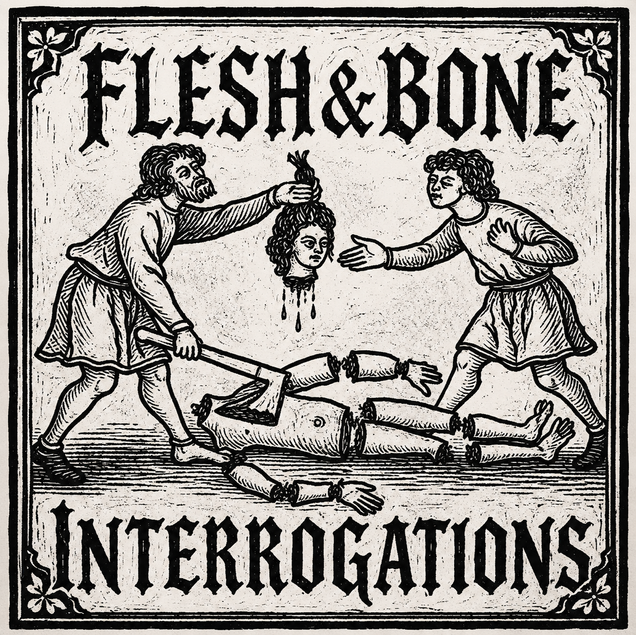
FLESH & BONE INTERROGATIONS is Joss Carter’s original movement and performance methodology: a rigorous, instinctive and exploratory physical practice developed over more than two decades of professional work across contemporary dance, physical performance, theatre, live art, creature performance, film, television and performance capture.
At its core, the methodology asks a simple but radical question:
What can the body become when we stop telling it how to move and start interrogating what it is capable of becoming?
FLESH & BONE INTERROGATIONS treats the body not simply as an instrument for executing movement, but as a living site of investigation. Flesh, bone, instinct, memory, emotion, psychology, imagination and physical environment are placed into dialogue with one another, allowing performers to investigate the boundaries between conscious control and instinctive response, technique and impulse, discipline and chaos, human and non-human.
The methodology emerged from Joss’s extensive training and professional experience in contemporary dance, classical ballet, somatic practice, physical theatre, experimental movement and performance, and has continued to evolve through his work as a performer, choreographer, movement specialist, creature actor, director, teacher and creative practitioner. He has taught FLESH & BONE INTERROGATIONS internationally through professional, educational and open-level classes and workshops, developing a practice that can be adapted to different bodies, disciplines, experience levels and creative objectives.
The word INTERROGATION is fundamental.
This is not movement training based solely on learning choreography, reproducing established forms or making the body look a particular way. It is an investigation into why the body moves, how it responds, what it remembers, what it conceals and what it might become when its habitual patterns are challenged.
Participants are encouraged to question their physical assumptions and investigate the relationship between action and reaction. Through repetition, experimentation, physical tasks, improvisation, sensory awareness, technical discipline and increasingly demanding physical states, the body is challenged to move beyond familiar solutions.
The practice deliberately moves between the technical and the primitive — between learned physical intelligence and instinctive behaviour. Joss’s published description of the methodology speaks of “establishing and exhausting the body” through technical and primitive forms of stimulating and self-disciplined actions and reactions, with the intention of energising and unlocking the corporeal existence of the individual.
Exhaustion therefore becomes a creative tool rather than simply a measure of physical fitness.
As habitual patterns begin to break down, performers can encounter different qualities of movement, rhythm, breath, weight, tension, impulse and presence. The objective is not to exhaust the body for the sake of endurance, but to discover what becomes possible when the body is taken beyond its most predictable responses.
FLESH represents sensation, instinct, vulnerability, emotion, impulse, animality and lived experience.
BONE represents structure, architecture, mechanics, limitation, strength and the physical framework that contains us.
INTERROGATION is the process that brings them together.
The methodology therefore exists in the space between flesh and structure, instinct and technique, consciousness and subconsciousness, control and surrender, human and animal, reality and imagination.
It is a practice of embodiment.
Rather than beginning with the question “How should this character move?”,
FLESH & BONE INTERROGATIONS can begin with questions such as:
What does this body need?
What does it fear?
What does it desire?
Where does it carry tension?
What happens when it loses control?
What changes when the body becomes unfamiliar to itself?
What physical behaviour exists beneath the character?
And what happens when that behaviour is allowed to become the character?
This makes the methodology particularly relevant to actor training, creature performance, character creation, movement direction, contemporary dance, physical theatre, performance art, motion capture and performance capture.
For creature performers in particular, FLESH & BONE INTERROGATIONS offers a route away from simply imitating an animal or monster. Instead, performers investigate the physical laws of an imagined being: its centre of gravity, skeletal structure, breath, rhythm, sensory awareness, instincts, territorial behaviour, relationship to space, methods of communication and relationship to other bodies.
The creature is constructed from the inside out.
Anatomy becomes behaviour.
Behaviour becomes character.
Character becomes identity.
Identity becomes transformation.
This principle lies at the heart of Joss’s wider artistic practice.
His work has consistently explored the boundaries between the human and non-human body, drawing upon contemporary dance, physical theatre, Butoh, ritual, horror, mythology, folklore, experimental performance and creature embodiment. Rather than treating these influences as fixed techniques to be reproduced, FLESH & BONE INTERROGATIONS uses them as territories for investigation.
The methodology is therefore both physical and psychological.
The body affects the mind.
The mind affects the body.
A change in breath can alter psychological state. A change in weight can alter character. A change in rhythm can alter intention. A physical restriction can create a new behavioural vocabulary. A repeated action can become ritual. An instinctive reaction can become character. An unfamiliar movement can reveal an unfamiliar identity.
The performer becomes both researcher and subject.
This investigative quality is central to the name itself: the body is questioned through practice rather than merely instructed through theory.
Yet despite its intensity, FLESH & BONE INTERROGATIONS is not founded upon aggression, competition or humiliation. Joss has described the environment in which the work takes place as non-judgemental, honest, caring and intimate, creating space for experimentation, vulnerability and transgression alongside rigorous physical investigation.
That balance is essential.
The work asks performers to go beyond what is comfortable, but it also asks them to become more attentive to themselves and others.
Intensity requires awareness.
Freedom requires responsibility.
Experimentation requires trust.
The methodology can therefore be adapted according to the needs of the individual or project. Joss subsequently developed Contemporary Movement & Performance Coaching, offering tailored individual and group sessions for physical-body awareness, research and development, new concepts and assisting directors with the development of casting and roles.
In this way, FLESH & BONE INTERROGATIONS is not a fixed sequence of exercises.
It is a framework for investigation.
Every body brings different histories, capabilities, limitations, habits, fears, instincts and possibilities. Every performer therefore enters the interrogation from a different starting point.
The methodology provides the conditions for discovery.
What emerges from those conditions belongs to the individual performer.
For some, the investigation may lead towards greater physical awareness. For others, it may reveal new character possibilities, unfamiliar movement vocabularies or more instinctive performance states. For creature performers, it can become a pathway towards embodiment. For dancers, it can challenge habitual technique. For actors, it can connect psychology with physical behaviour. For directors and choreographers, it can provide a practical research environment for discovering what a character, creature or concept could physically become.
Ultimately, FLESH & BONE INTERROGATIONS is about making the body unfamiliar again.
It asks us to temporarily dismantle the movement patterns, behaviours and assumptions that make us recognisable to ourselves, so that something else can emerge.
Not necessarily something monstrous.
Not necessarily something beautiful.
Something true to the investigation.
The grotesque and the beautiful are treated with equal curiosity. Vulnerability is not separated from strength. Instinct is not separated from intelligence. Human behaviour is not separated from animal behaviour. Failure is not necessarily failure; it can be information. Discomfort can become discovery. Exhaustion can become access. Strangeness can become vocabulary.
This is where the methodology connects directly with Joss Carter’s artistic identity, YOUR WORST NIGHTMARE.
YOUR WORST NIGHTMARE explores the shadows, creatures, impulses and identities that exist within the imagination.
FLESH & BONE INTERROGATIONS explores the physical mechanisms through which those things can become embodied.
One is the mythology.
The other is the method.
Together they form a creative practice concerned with transformation — transforming movement into behaviour, behaviour into character, character into creature, and imagination into physical reality.
At its deepest level, FLESH & BONE INTERROGATIONS is an invitation to stop treating the body as something that simply carries us through the world.
Interrogate it. Exhaust it. Listen to it. Challenge it. Trust it. Transform it.
Because somewhere beneath the trained body, the habitual body and the familiar body is another body waiting to be discovered.
FLESH & BONE INTERROGATIONS is the process of finding it.
